
"His Excellency, The High Priest"
A ancient Egyptian papyrus and a handful of other texts help us to better understand the significance of Luke's reference to the "most excellent Theophilus."

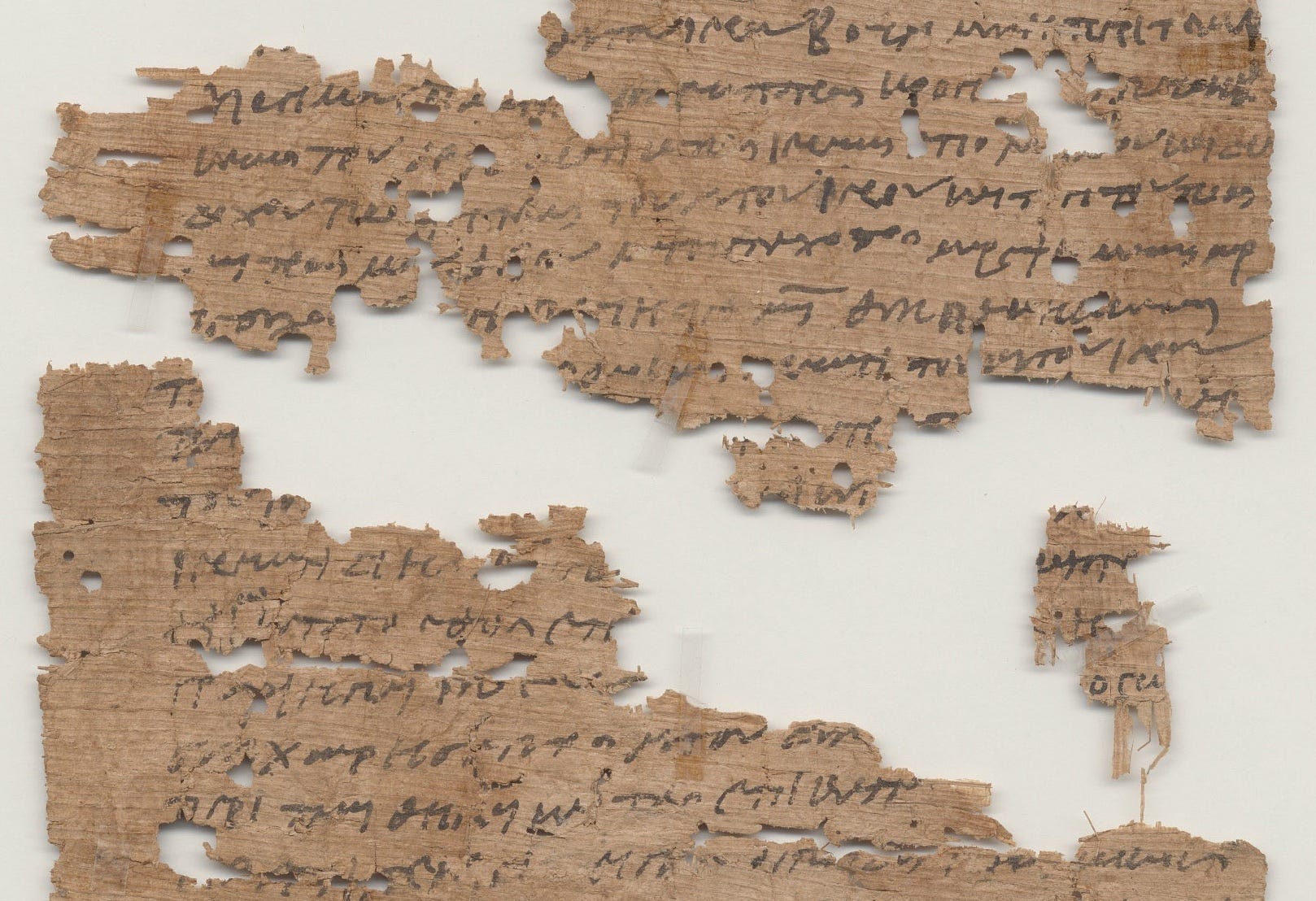
One of the main objections to the idea of linking Luke’s Theophilus with the high priest mentioned on the Joanna Ossuary is that over the past few centuries, many scholars have argued that the word kratistos found in Lk 1:3 (typically translated, “most excellent”) identifies Theophilus as a high-ranking “Gentile” official. Here are some examples:
John Wesley (1765): “Most excellent Theophilus—This was the appellation usually given to Roman governors.”
Adam Clarke (1831) “Theophilus appears to have been some very reputable Greek or Roman, who was one of St. Luke’s disciples.”
J.W. McGarvey (1872): “Nothing is known of Theophilus, but he is supposed to have been a Greek of high official rank.”
F.F. Bruce (1954): “Theophilus was a representative member of the intelligent middle-class public at Rome whom Luke wished to win over…”
Donald Guthrie (1990): “Theophilus…is described as ‘most excellent’ [kratiste] an expression which looks like an indication of social rank…He was clearly a Gentile…”
However, a late second-century Egyptian papyrus, affectionately known as HVG: P.Tebt. II 292,1 along with a handful of similar passages cited at the end of this article, provide us with an alternative interpretive option. The Egyptian text records the words of a woman named Isidora, who wrote to an official requesting that her son and nephew be circumcized.2 Here’s the relevant section of her letter: “I request that, in accordance with custom, a letter should be written…to his highness (kratistos) the high-priest in order that…the boys may be able to be circumcised…[My] husband Kronion son of Pakebkis, who now happens to be in Alexandria, will bring them before his highness (kratistos) the high-priest.”
Another translation renders the key phrase: “his excellency the high priest.” What’s particularly intriguing about this papyrus is that it provides clear evidence that the Greek adjective kratistos was applied, not merely to Roman governors (cf. Acts 23:26, 24:2, 26:25), but also to those who filled the office of high priest as well.3 In Roman Egypt of this period, the high priest oversaw all religious matters and also performed various secular duties as well, since he was a political appointee of the emperor.4
This was actually quite close to the situation in first-century Judea. The high priest Theophilus was appointed by the Imperial Legate, Vitellius, while he was governing Syrian affairs,5 and according to Josephus, after the reign of Herod the Great, “the government became an aristocracy, and the high priests were entrusted with a dominion over the nation.”6 In other words, just as in Egypt, the Judean high priests had both secular and religious responsibilities.7
According to Louw & Nida’s Greek Lexicon, the word krastistos pertains to “having noble status, with the implication of power and authority, often employed as a title — ‘excellency, most excellent, your honor.’”8 This is precisely the way Luke uses this word in verse 3 of his prologue. In other words, his use of kratistos helps readers to identify Theophilus as a man of power, authority, and high office. And because of this Egyptian papyrus, and others like it, we know that the word could also refer to a high priest as well, whether he lived in Egypt, Rome, or even Judea. In fact, one of the inscriptions I cite at the end of this article reveals that even the archangel Gabriel was called “most excellent,” and no scholar (at least that I’m aware of) has ever made the case that Gabriel was merely a Roman official.
Tal Ilan is an Israeli historian and scholar who has collected thousands of names from ancient Palestinian texts and inscriptions into an impressive database, and in her book, Integrating Women Into Second Temple History, she argues that “Identification of the same individual from two different sources can be almost certain in the case where the persons identified bear not only the same name but also the same title.”9
Since the adjective kratistos functioned as a title of respect and was appropriate both for Luke’s Theophilus and Theophilus the high priest, I think an excellent case can be made for identifying these two men as the same individual. In fact, the strength of this case increases significantly when we recall that, according to Acts 9, Paul was specifically commissioned by the chief priests to arrest and persecute the followers of Jesus. In short, Paul knew Theophilus the high priest personally. And since Luke later became Paul’s associate, a very plausible connection can be made between the Evangelist and the high priest. Finally, when we also recall that both the ossuary and the text of Luke’s Gospel feature an aristocratic woman named Joanna, and notice the way Luke places her in a position of prominence in his climactic final chapter, the case becomes very compelling.

One early advocate of this hypothesis was a German scholar named Johann David Michaelis. In 1777, he observed that if Luke wrote to Theophilus the high priest, who “was certainly of sufficient rank to be entitled to the appellation of kratistos,” his Gospel “must then be considered as an historical apology for the Christian religion, addressed to one of the heads of the Jewish nation.” After weighing the evidence in favor of this view, Michaelis then concludes with the following statement:
All these circumstances put together render the opinion highly probable that St. Luke’s Theophilus is no other than Theophilus the son of Annas, who is mentioned by Josephus. And if the opinion be true, as I really believe, it adds greatly to the credibility of St. Luke’s Gospel; for the Evangelist would hardly have ventured to dedicate to the son of that very Annas, who was High Priest when Christ was crucified, a narrative of facts performed in Palestine, unless he had been able to warrant their truth..10
A more recent advocate of this proposal is Australian NT scholar, Peter Bolt, who in his 2022 Luke Commentary published by The Gospel Coalition, argues that if Theophilus the high priest was the intended recipient, “then Luke’s narrative presents Jesus to a man who was at the centre of the Jewish circles that were largely responsible for rejecting Jesus. It is an ‘apologia’ (defense) as well as a ‘kategoria’ (accusation / critique).”
In my “humble” opinion, this identification has huge ramifications on the way we read and interpret the words of Luke’s narrative. As I see it, Luke’s Gospel was written as a kind of open letter, or public affidavit, submitted to the high priest while also published broadly (which explains some of the explanatory comments he makes for Gentile readers). In the end, his purpose was to set the record straight about Jesus. Here’s what he said and did, according to his closest disciples and witnesses, and here’s why he really was, and is, the promised Messiah.
I’ll continue to explore this topic in future articles, episodes, and videos, and will respond to some of the major objections I’ve received in recent months, such as whether the chronology between Theophilus and his granddaughter actually lines up with the individuals mentioned by Luke. So stay tuned!
NOTE:
Here are several additional texts that help us to see how the word
“kratistos” was used in the ancient world.
BEREA, GREECE (100-130 AD)
The high priest of the people, Flavius Paramonus, a most excellent man
ἀρχιερέα τοῦ ἔθνους Φ̣λ̣α̣ύ̣ιον Παράμονον ἄνδρα κράτιστον11
ATTICA, GREECE (165 AD)
The mighty high priest
τοῦ κρατίστου ἀρχιερέως12
MEMPHIS, EGYPT (171 AD)
Ulpius Serenianus, the most excellent high-priest
Οὐλπίου Σερηνι̣αν̣οῦ τοῦ κρατίστου ἀρχιερέως13
DELPHI, GREECE (180-190 AD)
The most excellent (lady) and high priestess of the people
την κρατιστην και αρχιερειαν του κοινου14
HIERAPOLIS, PHRYGIA (180-220 AD)
The most excellent high priest
τοῦ kρατίστου ἀρχιερέων15
TALMIS, EGYPT/NUBIA (215 AD)
The most excellent Muranos, successor to the high priesthood
τοῦ κρατίστου Μύρωνος δια- δεχομένου τὴν ἀρχιερωσύνην16
THESSALONICA, GREECE (261 AD)
Pontius Evangelius, the most powerful man and high priest
Ποντίου Εὐανγέλου τοῦ κρατίστου καὶ ἀρχιερέως17
ELAIOUSSA, CILICIA (1st - 3rd Century, AD)
A lion is referred to as “the mightiest of beasts”
θηρῶν κράτιστε καὶ θεῶν μύστα λέων τίνος φυλάσσεις χῶρον18
EGYPT / NUBIA (2nd - 3rd Century, AD)
A reference to angels: “Michael the highest, and Gabriel most excellent”
Μιχαὴλ ὕψιστε, Γαβριήλ κράτιστε19
Shane Rosenthal is the founder and host of The Humble Skeptic podcast. He was one of the original creators of the White Horse Inn radio broadcast, which he also hosted from 2019-2021, and has written numerous articles for various sites and publications, including TableTalk, Modern Reformation, Core Christianity, Heidelblog, and others.
Videos
An Archaeological Discovery Sheds Light on Luke
Have Archaeologists Discovered Biblical Bethsaida?
Related Articles
Julia Crispina…A Case Study in Historical Identification, Tal Ilan
Who is Theophilus? Notes to Ep. #79, Peter Bolt and others
The Implications of 70 AD, Shane Rosenthal
A Pre-70 Date for the Gospels & Acts, Shane Rosenthal
The Date of John’s Gospel, Revisited, Shane Rosenthal
Episodes
Who is Theophilus? #79 with Peter Bolt
Luke, Theophilus & Joanna, #80 with Jim Sibley
A Forensic Approach to the Gospels, #81 with J. Warner Wallace
Did Josephus Ever Mention Jesus? Episode #77 with T.C. Schmidt
Jesus in Josephus & Other Ancient Texts, Episode #78 with T.C. Schmidt
Faith Founded on Facts, Episode #15 with Lennox, Bauckham, and others
Stories of Jesus: Can They Be Trusted? Episode. #61 with Peter J. Williams
Are the Gospels History or Fiction? Episode #52 with John Dickson
Books
Luke’s Key Witness, Shane Rosenthal
Who Are Joanna & Theophilus? (e-book) Richard Anderson
The Historicity of Saint Luke, Wesley W.S. Lukas
Jesus & The Eyewitnesses, Richard Bauckham
Testimonies to the Truth, Lydia McGrew
Can We Trust The Gospels? Peter J. Williams
The fact that Egyptians practiced circumcision was noted by Herodotus: “The Egyptians and those who have learned it from them are the only people who practise circumcision” (Histories 2.36.3; cf. 2.37.2, and 2.104.2). In the Egyptian context, it was associated specifically with the priesthood, which could help us to make sense of Ex 19:6 in which God calls the people of Israel to be a “kingdom of priests and a holy nation.” In other words, during that period, circumcision was a well-established identification marker of priestly service and devotion.
At one point in his writing (War 1:68), Josephus did refer to “the high priesthood” as “one of the three most excellent things in the world, but in doing so, he used a slightly different form of the word (rather than using the adjective kratistos, he used the participle, kratisteuonta). This papyrus uses the word kratistos just as we find in Lk 1:3, namely, in the form of a title which signifies high office.
Pfeiffer, Stefan, “The Imperial Cult in Egypt,” in The Oxford Handbook of Roman Egypt, edited by Christina Riggs, (Oxford: Oxford University Press, 2012), 84–101.
Josephus, Ant. 18:120-123
Ibid., Ant. 20:251
In fact, Chris de L’isle argues here that in Roman Athens, “The most prestigious priesthoods…were often held by the same narrow elite which held the highest political offices.”
Johannes P. Louw and Eugene A. Nida, Greek–English Lexicon of the New Testament (New York: United Bible Societies, 1989), 565.
Tal Ilan, Integrating Women Into Second Temple History (Peabody, MA: Hendrickson, 2001), 218. This particular chapter was originally published as a journal article in The Jewish Quarterly Review, Vol. 82, No. 3/4 (Jan-Apr., 1992), 361-381.
John David Michaelis, Introduction to the New Testament, Vol 3, part 1, translated by Herbert Marsh (Cambridge: John Burges, Printer to the University, 1801), 236-240. The first German edition of Michaelis’ work appeared in 1750, but Michaelis didn’t adopt this view of Theophilus until he released his fourth edition in 1777.
EKM 1 Beroia 7 (line 71). This is the Berea mentioned in Acts17:10.
IG II 2090. See also this English translation.
BGU I 347 Kol. I. See also here.
Temple de Kalabchah 193. See also IGRR 1.1356 / SB 5.8534.
IG X2 1 200 (line 6-7)
I Cilicie 20. See also SEG 30.1562
SB 18:13663 This inscription appears on a gemstone and was likely used as a magic amulet for the purpose of warding off evil spirits.
I'll have to see if I can find the storie. I was thinking Jesus was answering the fool according to his own folly. Prov 26:5. But, I had never found anything, except what Enoch described as the chambers in the earth where the righteous await the Lord and the unrighteous the judgement. Places in Sheol. Also, the other place, Tartarus, where the fallen angels await eternal damnation.
The parable is interesting since it is describing after death conditions of Sheol of people being conscious in different living conditions like the book of Enoch describes. Yet, the idea of the poor being rewarded and the rich suffering? Possibly this was the reasoning of this leadership. Jesus did accuse them of neglecting their personal responsibilities in this life. Also, weren't these high priests Sadducees? They didnt believe in resurrection from the dead.