
Rethinking Luke's Prologue, Part 5
Selections from John Mill (1644-1707), Friedrich Bleek (1793-1859), B.F. Westcott (1825-1901), and Henry Cadbury (1883-1974).

The following selections have been abridged and edited for contemporary readability. Use these links to access Part 1, Part 2, Part 3, or Part 4 of this series. Click here to get a pre-release PDF of Shane’s book Luke’s Key Witness, and here to watch his webinar, “Rethinking Luke’s Prologue,” (exclusively for paid subscribers).
John Mill (1707), Principal of St. Edmund Hall, Oxford University
It appears from the introduction to Luke’s Gospel that the many narrations referred to in the first verse consisted of “things fulfilled among us,” that is, of things done by Christ among the first professors of the faith, of which number Luke reckons himself.1

Friedrich Bleek (1859), Professor of Theology at the University of Bonn
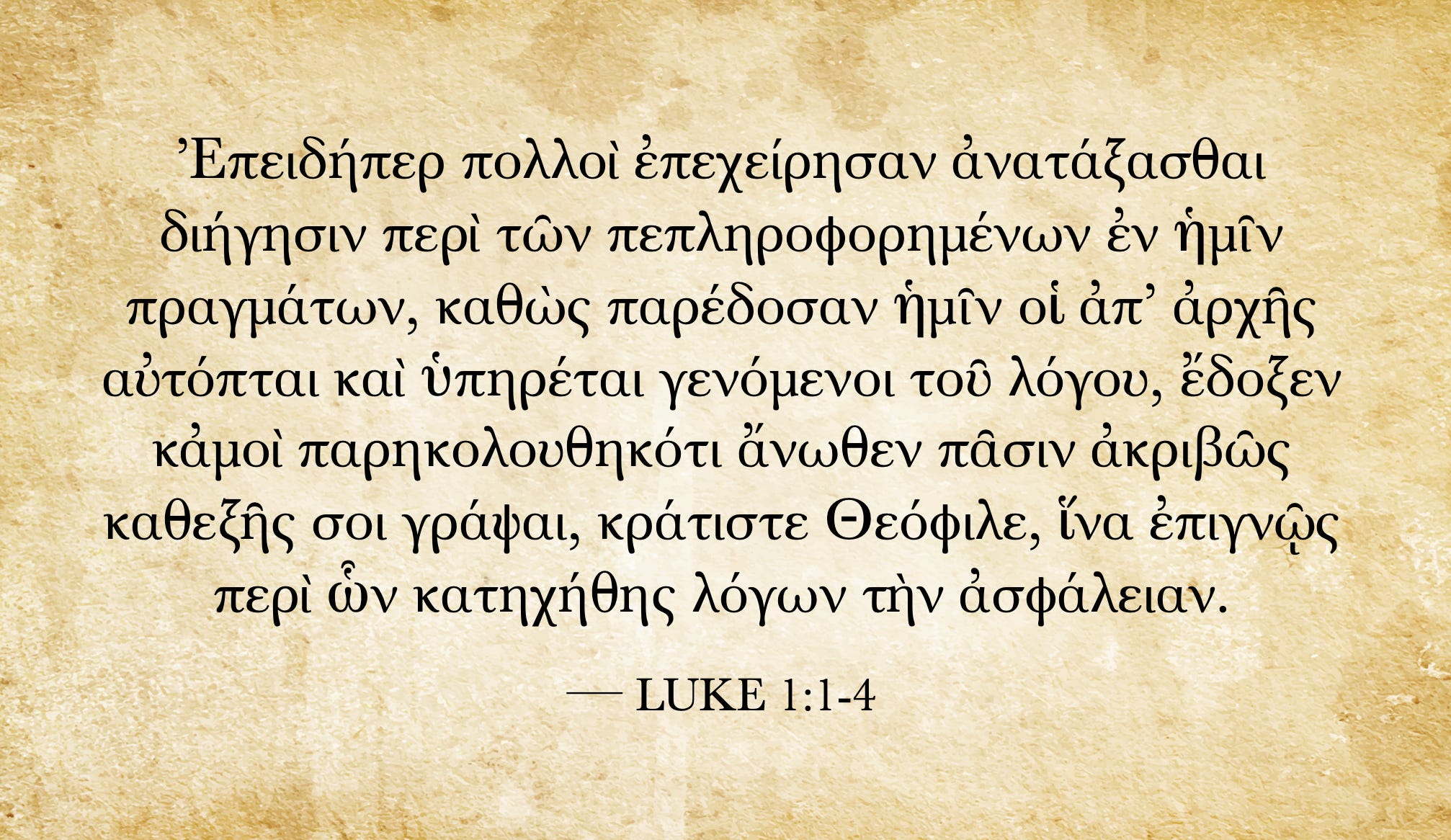
The preface of Luke’s Gospel certainly speaks of other evangelic histories already in existence; but on the face of it, it conveys the impression that it was not composed at a very late date. A writer in the latter half of the second century could hardly have spoken of τῶν πεπληροφορημένων ἐν ἡμῖν πραγμάτων [Lk 1:1, the things fulfilled among us]. It is utterly improbable that any evangelist who only appropriated the treatise of another which he had before him, adding to it only a few facts or discourses, could have spoken of his undertaking as the preface says, ἔδοξεν κἀμοὶ παρηκολουθηκότι ἄνωθεν πᾶσιν ἀκριβῶς καθεξῆς σοι γράψαι…[Lk 1:3, it seemed good to me, having been a follower from the beginning, to write all things orderly for you…]2

B.F. Westcott (1860), Regius Professor of Divinity, Cambridge University
It is evident that Luke represents his Gospel as a faithful embodiment of the ‘Evangelic tradition.’ He finds no fault with the basis on which the earlier writers rested. His own determination is placed on an equal footing with theirs (ἔδοξε κάμοί); but he claims for himself a knowledge of the Apostolic preaching continuous from the first, complete, exact, and for his writing, a due order (Lk 1:3, παρηκολουθηκότι ἄνωθεν πᾶσιν ἀκριβῶς καθεξῆς σοι γράψαι). Each word in the sentence contributes an important element to the completeness of the whole idea.
Luke appears to speak of a gradual unfolding of the whole Gospel in the course of the Apostolic work which he had watched from the first step throughout every detail. The same term used in verse 3 (παρακολουθεῖν) describes the personal attendance on a teacher and the careful following of teaching.3 The long companionship seems to be the criterion of the complete knowledge. And this view of the notion implied in ‘following’ illustrates the meaning of the next words. Luke’s ‘continuous familiarity’ with the subject gave him a knowledge of the whole cycle of the ‘tradition,’ and not only of particular periods or of particular parts of it. His knowledge started from the first and extended to every point…4

Henry J. Cadbury (1922), Professor of Theology at Harvard Divinity School
There seems at first sight little doubt that the writer distinguishes his own group from the αὐτόπται καὶ ὑπηρέται [Lk 1:2 eyewitnesses and servants] and that both he and the earlier writers are definitely excluded from the category of eyewitnesses. However, if we accept the probable meaning of παρηκολουθηκότι ἄνωθεν [Lk 1:3 having been a follower from the beginning] it cannot possibly exclude eyewitnesses and so we cannot insist on such an exclusion here. Additionally, παρηκολουθηκότι may mean precisely that the writer was a witness or actor in the scenes described. More intimate contact with events is not excluded by the word, and in the following passages it seems almost to require the meaning of actual presence or participation in the events. For example, this word in Josephus, Contra Apion 1:53, refers directly to the author’s own presence and participation at the events recorded by him. We must therefore leave the possibility open that the author is claiming for himself actual presence and participation in the events described. There appears to be no warrant for assigning to the word the sense of deliberate investigation, although Luke’s apologists love thus to modernise it. The writer’s information had (notice the perfect tense) come to him as the events took place; it was not the result of special reading and study. His acquaintance with the subject, whatever its degree of intimacy, was something already in his possession.5

Luke’s use of the perfect tense implies that at that time the author found himself possessed of information which had come to him through continuous contact (hence the metaphor of following) with the events. The perfect participle is almost invariably used wherever the verb has this meaning. It has the true perfect sense of information as a result of earlier continuous association.
In the same way ἄνωθεν [from the beginning] must be understood, not of the early point in the history to which the author carried back his researches, but rather of that early time in his own life at which his touch with events began and from which it has continued. This interpretation is the chief obstacle to understanding παρηκολυθηκότι of actual presence or participation. It is interesting to watch the commentators “kick against the pricks.” I quote the most recent ones:
“Impossible is the interpretation which makes Luke an active witness of all the events which he is about to set forth, although this is linguistically possible…This would make Luke an eyewitness from the beginning, which he emphatically declares not to have been the case.” — Zahn
“This verb has naturally a literal meaning, to follow the events as a witness…But this sense is excluded by what Luke has said in verse 2. One must have recourse therefore to a metaphorical meaning: follow in thought, and here, make an inquiry.” — Lagrange
Evidently we have to choose either a strict construction of the earlier clauses of the preface, which would exclude Luke from the eyewitnesses, or the natural sense of παρηκολουθηκότι, which would include him. The former alternative has been the usual choice, but the latter may seem, after review of the evidence, really preferable.
Whether we are arguing for or against an early date and Lucan authorship, we will do well to eschew the conventional habits of settled exegetical conformity. Whether we believe Luke or not, the possibility must be left open that the author is claiming in the very beginning of his work to have been long in such close contact with the series of events which he unfolds as to be possessed of first-hand contemporary knowledge about them, and that perhaps he means to claim the knowledge of an actual eyewitness. At any rate he says nothing of research.6
Click here to read Part 6 of this series
John Mill, Prolegomena (1707), cited in Nathaniel Lardner’s History of the Apostles and Evangelists, Writers of the New Testament, Second Edition (London: J. Buckland and W. Fenner, 1760), 286.
Friedrich Bleek, An Introduction to the New Testament (Edinburgh: T & T Clark, 1869). The first German edition was released in 1861.
Papias, cited by Eusebius, H.E. 3.39, compared with 1 Tim 4:6; 2Tim 3:10.
Brooke Foss Westcott, An Introduction to the Study of the Gospels, Sixth Edition (London: Macmillan & Co., 1881), 172-174. This work was first published in 1860. While Westcott correctly defines παρηκολουθηκότι as indicating “long companionship,” in the above quote, he appears to suggest that Luke’s knowledge was rooted in the long companionship of the apostles only. In my view, however, Luke makes clear that, like the eyewitnesses cited in verse 2, he too had been a follower “from the beginning” (Lk 1:3, παρηκολουθηκότι ἄνωθεν). Here we should note that throughout the Gospels, references to “the beginning” in contexts such as this one, are invariably connected to the beginning of Jesus’ public ministry (Mk 1:1, Lk 1:2, Jn 15:27, Acts 1:21-22, 10:36-37). Though Luke had received narratives delivered by eyewitnesses, he was not exclusively dependent on their testimony, since he specifically states in verse 1 that Jesus fulfilled these things “among us,” which includes the author himself (as John Mill noted above).
Henry Cadbury, “Commentary on the Gospel of Luke,” in The Beginnings of Christianity, Part 1, The Acts of the Apostles edited by F.J. Foakes Jackson & Kirsopp Lake (London: Macmillan & Co., 1922), 497-502. This essay appears in Appendix C.
Henry Cadbury, “The Knowledge Claimed in Luke’s Preface,” The Expositor XXIV, Eighth Series, No. #144, December 1922 (London: Hodder & Stoughton), 401-420.