
Cambridge NT Scholar George van Kooten on the Date & Authorship of John's Gospel
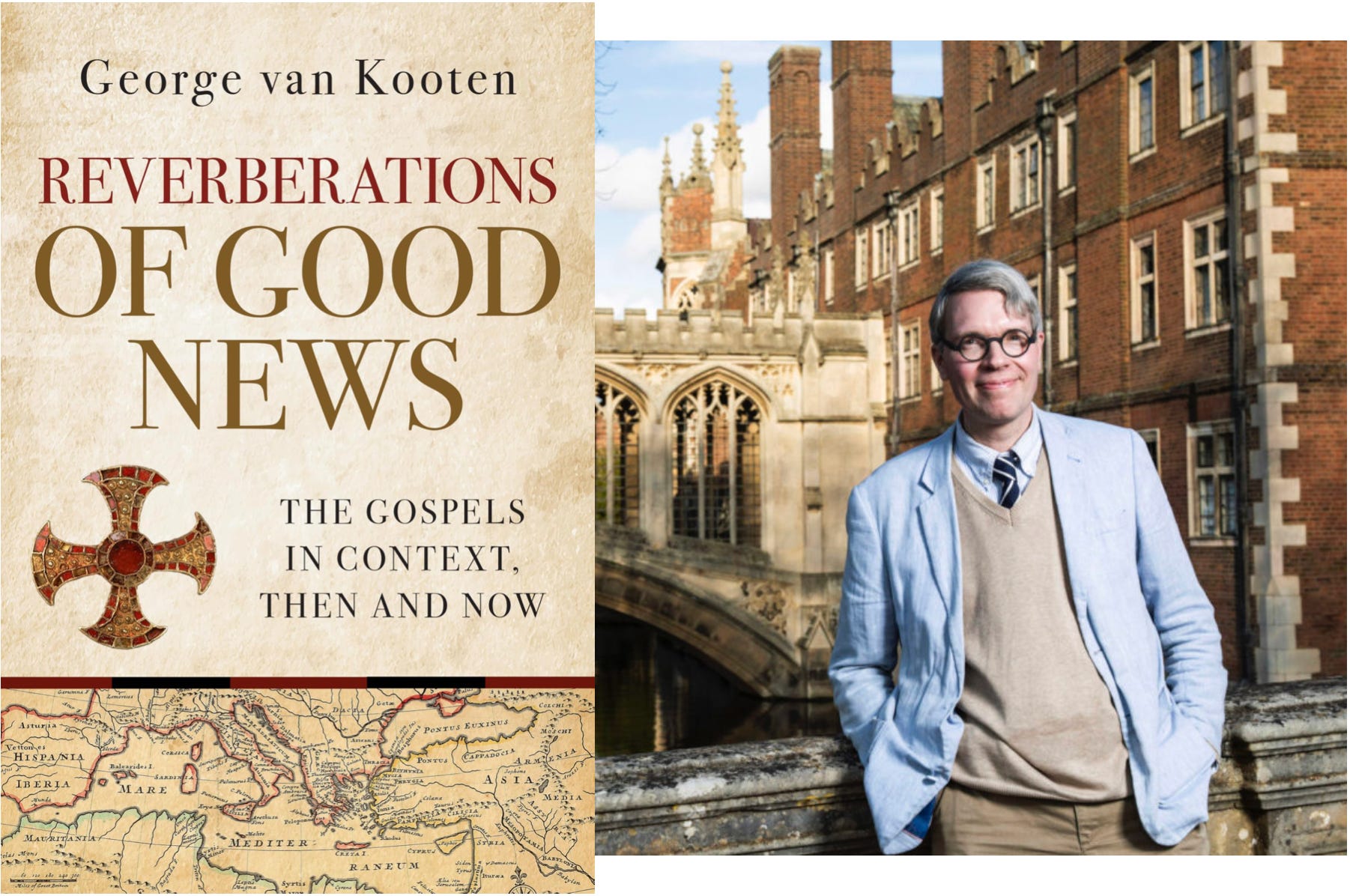
In his new book, Dr. van Kooten calls for a radical redating of the Fourth Gospel and says that since the author was known to the high priest, he cannot have been John the son of Zebedee.

In late 2024, I wrote about a paradigm shift that was taking place among NT scholars with respect to the date of the Fourth Gospel. Until the discovery of the John Rylands fragment in 1935, it was common to view John’s Gospel as a product of the early second century, and since that time, apart from a few outliers, most scholars—whether conservative or liberal—ended up dating this text to sometime in the late first century (typically around the 80s or 90s). However, in recent years, several prominent NT scholars have indicated that their views have changed, and that they are now open to a much earlier dating of John. This includes Richard Bauckham, N.T. Wright, James Charlesworth, Johnathan Bernier, Peter J. Williams, William Weinrich, John Dickson, Daniel Wallace, and Michael J. Gorman.
A few of the scholars cited above specifically credited the work of Cambridge NT scholar George van Kooten, who has been arguing in various places that the most important clue about the date of the Fourth Gospel is found in John 5:2.1 In his recent book, Reverberations of Good News (2026), Dr. van Kooten makes the following observations:
I have recently argued for a radical redating of the Gospel of John on the basis of its internal evidence, and consequently for a re-reading of the Gospel in its historical context. A clue to the date when this Gospel was written is found in its description of a huge, monumental pool complex at the beginning of John 5, in the narrative of a paralysed man who was healed in the Pool of Beth-zatha. In John 5:2, this pool is described as follows: ‘There is in Jerusalem by the Sheep Gate a pool, called in Hebrew Beth-zatha, which has five porticoes (stoai).’ I have demonstrated that the formula ‘There is in’, with the use of the present tense is followed by a localization in a particular place and a description of the building with some characterization that would help to identify it, is used in Greek literature — by geographers such as Herodotus (fifth century BCE), Strabo (first century BCE), and Pausanias (second century CE) — to refer to a building which is still standing, and which readers might find as described if they were to visit the place. Such texts also regularly reference a nearby gate, the ancient equivalent to the postal area-code system, where one could enter the city under consideration. Therefore at the moment when the author of John’s Gospel was writing, the colonnaded pool and the nearby Sheep Gate must still have existed…We know from Josephus, however, that at the very beginning of the First Jewish Revolt (66-70 CE), Roman troops destroyed the Bezetha area of Jerusalem, where the pool was located, and that after the Roman destruction of the entire city in 70 CE, the city’s gates and walls were demolished as well.2
I’ve not heard anyone make the argument that when ancient chroniclers referred to a specific gate, this was the “ancient equivalent to the postal area-code system.” If this stands up to scrutiny—I’ll investigate this claim carefully—this would be a strong argument in favor of using John 5:2 as evidence of an earlier date. Those who have not been persuaded by the use of this passage have typically argued that ruins of the pool may still have been present in John’s day; however, as van Kooten points out, John specifically indicates that the pool “IS in Jerusalem near the Sheep Gate” (ἔστιν ἐν τοῖς Ἱεροσολύμοις ἐπὶ τῇ προβατικῇ). In other words, the city, the temple gate, and the pool all seem to be described as being present at the time of John’s writing.
Concerning the authorship question, van Kooten states that “John’s Gospel portrays Jesus coming to Jerusalem, and quite regularly too, on at least three occasions. This John is therefore unlikely to be John the Zebedee, one of the Galilean Disciples, and is more likely John the Elder, who was known to the high priest in Jerusalem, and of whom Papias, the bishop of Hierapolis (c 101-110 CE) gives an account.”3
According to van Kooten, Papias made a distinction between John the Elder and John the Apostle, and “implies that John the Elder wrote the Gospel of John.”4 Papias’ view, he argues, “is entirely consistent with the Gospel’s own statement that its author is known to the high priest (Jn 18:15-16): this would be impossible if John were the Galilean fisherman (John the Zebedee) who had just arrived with Jesus in Jerusalem for the Passover festival.” Taken together, the features of John’s Gospel therefore “suggest that the author is a Greek-speaking employee…in the high priestly administration of the Jerusalem temple.”5
I’ve advocated a similar view on various episodes of The Humble Skeptic, and in my lengthy essay, “The Identity of the Beloved Disciple” (which is a free download for paid subscribers—you’ll find a link in the resources section below). In my view, the author of the Fourth Gospel was likely a member of the high priestly family, and quite possibly John, the son of Theophilus, who we know from the inscription on the Joanna ossuary. Another candidate I propose in my essay is John Mark (cf. Acts 12:12, 15:37), since he was likely the owner of the gated home in Jerusalem with the “upper room,” which would explain his presence at the seat of honor next to Jesus at the Last Supper. According to Col 4:10, he was a cousin of Barnabas, which would indicate that he too was a Levite (Acts 4:36), thus making it plausible that he was known to the high priest.
In another post, I’ll discuss some of the things Dr. van Kooten says about the Synoptic Gospels.
Shane is the founder and host of The Humble Skeptic and the author of Luke’s Key Witness (forthcoming). He was one of the creators of the White Horse Inn radio broadcast, which he produced for several decades and hosted from 2019 to 2021. Shane has written articles for The Federalist, TableTalk, Modern Reformation, Core Christianity, and many other publications. He lives with his family in the greater St. Louis area.
RELATED RESOURCES
Essays & Articles
The Identity of the Beloved Disciple, Shane Rosenthal
The Date of John’s Gospel, Revisited, Shane Rosenthal
John’s Gospel: Are We Witnessing a Paradigm Shift? Shane Rosenthal
John 5:2 “There is in Jerusalem…” Shane Rosenthal
A Pre-70 Date for Revelation? Shane Rosenthal
A Pre-70 Date for the Gospels & Acts, Shane Rosenthal
The Implications of 70 AD on the Date of the Gospels & Acts, Shane Rosenthal
Authenticating The Fourth Gospel, Shane Rosenthal
Outside the Gospels, What Can We Know About Jesus? Shane Rosenthal
Things Completely Fulfilled Among Us, Shane Rosenthal
His Excellency, The High Priest, Shane Rosenthal
Water Into Wine?, Shane Rosenthal
Videos
An Archaeological Discovery Sheds Light on Luke
History, Archaeology & Luke’s Most Excellent Theophilus
Have Archaeologists Discovered Biblical Bethsaida?
Episodes
Is John Late & Unreliable? Humble Skeptic #51 with Daniel Wallace
Which John Wrote John? Humble Skeptic #50
In the Beginning Was the Word… Humble Skeptic #75 with John Ronning
Questioning The Fourth Gospel, Humble Skeptic #49 with Richard Bauckham\
Stories of Jesus: Can They Be Trusted? Humble Skeptic #61 with Peter J. Williams
Are the Gospels History or Fiction? Humble Skeptic #52 with John Dickson
Faith Founded on Facts, Humble Skeptic #15
The Jesus of History, Humble Skeptic #12
Lazarus, #84 with Richard Bauckham & T.C. Schmidt
Who is Theophilus? #79 with Peter. Bolt
Did Josephus Ever Mention Jesus? with T.C. Schmidt
Books
Reverberations of Good News, George van Kooten
Redating the New Testament, John A.T. Robinson
Redating Matthew, Mark & Luke, John Wenham
Rethinking the Dates of the New Testament, Jonathan Bernier
Jesus & The Eyewitnesses, Richard Bauckham
Josephus & Jesus, T.C. Schmidt
The Date of Acts & The Synoptic Gospels, Adolph von Harnack
Can We Trust The Gospels? Peter J. Williams
Is Jesus History? John Dickson
Testimonies to the Truth, Lydia McGrew
Luke’s Key Witness, Shane Rosenthal

George van Kooten, Reverberations of Good News: The Gospels in Context, Then and Now (Grand Rapids: Eerdmans, 2026), 249-250.
Ibid. p. 289.
Ibid.
Ibid. 291.