
Rethinking Luke's Prologue, Part 8
The importance of recognizing the parallel structure of Luke's opening statement.


For earlier parts of this series on “Rethinking Luke’s Prologue,” use these links:
Part 1 with Thomas Randolph; Part 2 with Johann L. Hug; Part 3 with Daniel Whitby and George Gleig; Part 4 with John Jones and George Moberly; Part 5 with John Mill, Friedrich Bleek, B.F. Westcott and Henry Cadbury; Part 6, featuring a discussion of 1st and 2nd century sources, and Part 7 featuring G. Wetzel, George L, Hahn, and Johann Peter Lange. Click here to get a pre-release PDF of Shane’s book Luke’s Key Witness, and here to watch his webinar, “Rethinking Luke’s Prologue” (exclusively for paid subscribers).
In an earlier part of this series, I cited the words of a German scholar by the name of Johann L. Hug, who stated that Luke’s prologue “is presented in two parts, one general (1:1-2), and the other particular (1:3-4).” In the first section, Luke acknowledges that many of his predecessors had already crafted narratives about Jesus, and in the second section, he specifically indicates that this is the point of his own narrative to Theophilus.
This becomes increasingly clear when we consider the implications of the words we find at the beginning of verse 3: ἔδοξεν κἀμοὶ (“it seemed good also to me…”). In other words, just as these others have done, Luke is endeavoring to do for the recipient of his Gospel. Here, it’s worth pointing out that in her widely acclaimed book, The Preface to Luke’s Gospel (1993), Loveday Alexander argues that it was a relatively standard feature of ancient prologues to begin with a formal acknowledgement of the work done by others on this same topic:
It is normal in Greek prefaces of all kinds to introduce the subject-matter of the book…and thus inevitable that the author’s own subject will often first be described as that of his predecessors. Cadbury is thus quite correct to observe that Luke’s words [in verse 1] apply to his predecessors, but this does not mean that they may not be describing his own project as well: in fact they would almost certainly have been understood that way by contemporary readers.1
Several pages later, Alexander went on to say that ancient references to the work of one’s predecessors were effectively there “to reassure the reader that the subject is worth spending time on.”2 So it appears that Luke’s introduction followed this well-known pattern of referencing the contributions of others, which also had the effect of highlighting the significance of the subject that was being addressed for Theophilus in particular.
Joseph Fitzmyer is another commentator who recognized the parallel structure of Luke’s opening remarks:
In studying the prologue, the reader should not fail to note its balanced form, in which both the protasis (vv. 1-2) and the apodosis (vv. 3-4) contain three parallel phrases. This is best seen in the Greek text itself because it cannot be preserved easily in translation. There is also a formal contrast between the “many” and “I too,” between “compile an orderly account” and “put them systematically in writing,” and lastly between the…“just as,” “so that…”3
Gregory Sterling similarly observed that, “There is a striking balance in both content and sequence between vv. 1-2 and 3-4,” and listed several features that both sections appear to have in common.4 Once the parallel structure of the two halves of Luke’s prologue is recognized, I believe this insight can help us to interpret some of the specific words and phrases that Luke employs.5 The reason for this is relatively simple. If the two sections are parallel, then we should be able to compare what Luke says in the first half with a similar word or phrase in the second half.
Here is my own translation of Luke’s prologue, presented in two sections: one general, and the other particular:
GENERAL (1:1-2)
Inasmuch as many have endeavored, each to set in order an account of
the things that have been completely fulfilled among us, just as the eyewitnesses
and officers of the word delivered to us from the beginning…
PARTICULAR (1:3-4)
…it seemed good to me also, as one who had been a follower from the beginning,
to write everything accurately and in order for you, most excellent Theophilus,
so that you may know the certainty of the things you’ve been told.
I’ll explain some of my word choices in a future post, but for now, I’d like you to notice how many of the words and phrases in the first section are essentially parallel to the words and ideas in the second section:
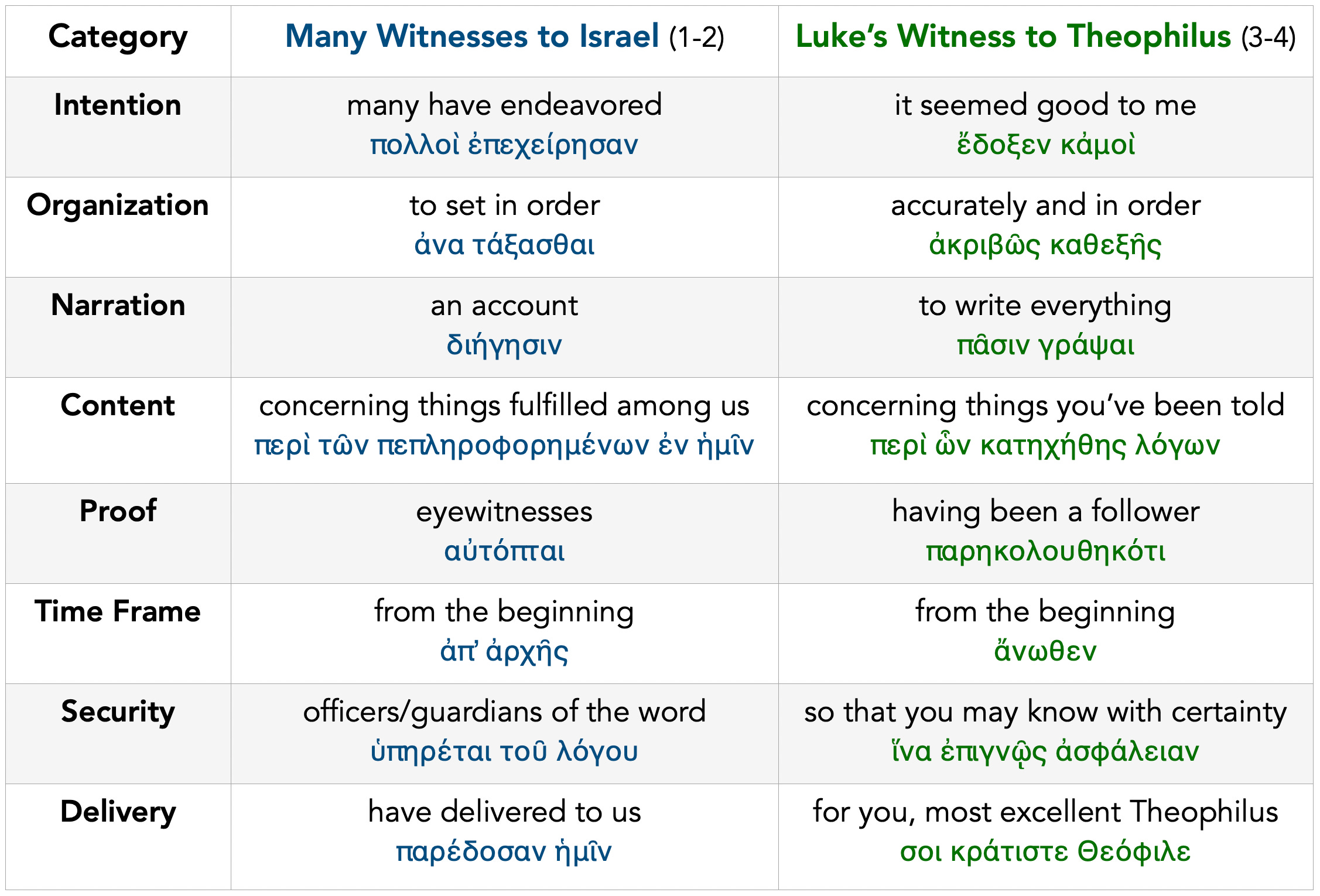
Now, as you can see above, in most cases, Luke used an alternative word or phrase as he presented these parallels. But once the overall pattern is recognized, I believe this can help us greatly when it comes to correctly interpreting Luke’s intended meaning. Thus, just as he referred to many who were eyewitnesses from the beginning (Lk 1:2), in the same way, he tells Theophilus that he too was a follower from the beginning (Lk 1:3).
Some translate the word ἄνωθεν in verse 3 to mean “for a long time,” which weakens the parallel, but once we recognize the pattern, it makes more sense to translate ἄνωθεν as being synonymous with the parallel phrase ἀπ’ ἀρχῆς in verse 2. In short, Luke has used slightly different words to say essentially the same thing.6 Additionally, as we’ve seen throughout this series, the word παρηκολουθηκότι typically refers to physical presence (i.e., literal following) in contrast to inquiring by means of others. But if the word is interpreted in this latter sense, the parallel would be greatly reduced. All the other narratives about Jesus were crafted by first-hand witnesses, and yet here, Luke is freely admitting that his knowledge is second-hand? How exactly is this supposed to give Theophilus certainty?
If, however, the pattern I have outlined above is valid, then it makes better sense to see Luke as a parallel (rather than dependent) witness. As a member of the believing community, he did receive other narratives about Jesus from the eyewitnesses, but he wasn’t exclusively dependent on their testimony because he says that he, too, had been a follower from the beginning. Here it’s also important to point out that this interpretation fits well with many other NT passages (Mk 1:1, Lk 3:23, 23:5, Jn 1:41, 2:11, 16:4, Acts 1:21-22, 10:36-37, 13:24-33, 1Jn 1:1), including a really important passage from John’s Gospel in which Jesus specifically told his followers: “You will also testify, because you have been with me from the beginning” (Jn 15:27).
To be continued…
FOR FURTHER STUDY
Rethinking Luke’s Prologue, Part 1, Thomas Randolph
Rethinking Luke’s Prologue, Part 2, Johann L. Hug
Rethinking Luke’s Prologue, Part 3, Daniel Whitby and George Gleig
Rethinking Luke’s Prologue, Part 4 with John Jones and George Moberly,
Rethinking Luke’s Prologue, Part 5 with Mill, Bleek, Westcott, and Cadbury
Rethinking Luke’s Prologue, Part 6, featuring 1st and 2nd century sources
Rethinking Luke’s Prologue, Part 7, with Wetzel, Hahn, and Lange
Things Completely Fulfilled Among Us, Shane Rosenthal
His Excellency, The High Priest, Shane Rosenthal
The Implications of 70 AD on the Date of the Gospels & Acts, Shane Rosenthal
A Pre-70 Date for the Gospels & Acts, Shane Rosenthal
Outside the Gospels, What Can We Really Know About Jesus?, Shane Rosenthal
Is Luke a Trustworthy Historian?, Sir William Ramsay
Can We Trust Luke’s History of the Early Jesus Movement? Shane Rosenthal
On Faith & History, Shane Rosenthal
AUDIO
Who is Theophilus? Humble Skeptic #79 with Peter. Bolt
Luke, Theophilus & Joanna, Humble Skeptic #80 with Jim Sibley
A Forensic Approach to the Gospels, Humble Skeptic #81 with J. Warner Wallace
Why The Gospel Holds Up as History, Faith Lab with Craig Keener
Lazarus, Humble Skeptic #84 with Richard Bauckham & T.C. Schmidt
VIDEO
Rethinking Luke’s Prologue: A Webinar by Shane Rosenthal for Paid Subscribers
Loveday Alexander, The Preface to Luke’s Gospel (Cambridge: Cambridge University Press, 1993), 107-108.
Ibid., 116.
Joseph A. Fitzmyer, The Gospel According to Luke I-IX (Garden City, NY: Doubleday, 1981), 288.
Gregory E. Sterling, Shaping The Past to Define The Present: Luke-Acts and Apologetic Historiography (Grand Rapids: Eerdmans, 2023), 22. See also Sterling’s helpful chart on that same page.
See also Blass, Debrunner & Funk, A Greek Grammar of the New Testament, (Cambridge: Cambridge University Press,1961), 242; Darrell L. Bock, “Understanding Luke’s Task: Carefully Building on Precedent (Luke 1:1-4),” Criswell Theological Review 5.2 (1991) 183-201; David L. Tiede, Luke, Augsburg Commentary on the New Testament, *(Minneapolis: Augsburg, 1988), 33; Henry Cadbury, “Commentary on the Gospel of Luke,” in The Beginnings of Christianity, Part 1, The Acts of the Apostles edited by F.J. Foakes Jackson & Kirsopp Lake (London: Macmillan & Co., 1922), 497-502.
In Acts 26:4-5, Luke alternates between ἄνωθεν and ἀπ’ ἀρχῆς, where the same meaning is implied.
So well done and beautiful and convincingly clear. Thank you for this. Especially your dashing:
How exactly would that convince a Theophilus of the certainty of these events (if Loukios of Cyrene were to be read in accord with the churches' as customary as wrong narrative)?
Next week I am going to visit the ΜΕΛΙΤΗ of antiquity (not Malta) where ΠΑΥΛΟΣ and ΛΟΥΚΑΖ stranded with about 270 other people after a rough ride through the Mediterranean Sea on their way from Crete towards Rome. (Another falsehood installed and maintained against better evidence by these same churches and their sects.)
Even a Socrates in the City knows better than our "fairhful translators of God's Word"? Shame on them. (And this is only one of their slightest mistakes.)