
Rethinking Luke's Prologue, Part 9
Many (πολλοὶ) narratives about Jesus had already been written in Luke's day (Lk 1:1). Matthew and Mark were certainly earlier, but does the word πολλοὶ imply that other Gospels have been lost?


In the opening of his Gospel, Luke indicates that by the time he set out to write, other eyewitnesses had already crafted narratives about the things Jesus “fulfilled among us.” What is curious, however, is that when describing these other narratives, Luke uses the adjective πολλοὶ, meaning “many.” Most New Testament scholars are confident that both Matthew and Mark were written before Luke, but the question remains whether this word can be understood to refer exclusively to these two earlier Gospels.
The word πολλοὶ frequently appears throughout Luke’s Gospel and is used by the author to refer to the large number of fish that caused Peter’s nets to break (Lk 5:6), the great crowds who came to hear Jesus speak (Lk 5:29, 6:17, 8:4, 14:25), and the many who witnessed his miracles (Lk 5:15, 6:17, 7:11, 9:37). In fact, on one occasion, the crowd was so big in fact that Luke described it using the word μυριάδων. Basically, he was saying that tens of thousands showed up to see Jesus that afternoon (Lk 12:1).
The fact that large crowds of this nature are corroborated by the other Evangelists (Mt 4:25, 8:1, 15:38; Mk 4:1, 6:33, 8:19; Jn 6:2, 7:30, 12:9–12), as well as by the Jewish historian Josephus (Ant. 18:63),1 poses a significant challenge for those who attempt to argue that Jesus never existed. Think about it for a moment: if the story of Jesus were essentially rooted in fiction, how did his movement ever get started in the first place? Wouldn’t the residents of Judea, Galilee, Syria, the Decapolis, and Idumea (cf. Mt 4:24; Mk 3:7ff; Lk 4:37, etc.) immediately recognize that all the stories circulating about this famous miracle worker named Jesus were patently false? And yet, it is clear from a variety of sources that the Jesus movement experienced exponential growth in the middle part of the first century.2
The Appeal to Common Knowledge
Throughout the sermons recorded in Acts, Luke repeatedly highlights the fact that Jesus’ story was widely known. Less than two months after the crucifixion, Peter told a large crowd in Jerusalem that Jesus was “a man attested to you by God with mighty works and wonders and signs that God did through him in your midst, as you yourselves know…” (Acts 2:22).
Nearly a decade later, Peter said something similar at the home of a Gentile centurion in Caesarea: “[Y]ou yourselves know what happened throughout all Judea, beginning from Galilee after the baptism that John proclaimed: how God anointed Jesus of Nazareth with the Holy Spirit and with power. He went about doing good and healing all who were oppressed by the devil, for God was with him. And we are witnesses of all that he did…” (Acts 10:37–39).
When Festus told Paul that he was “out of his mind” while he was on trial in Caesarea, the apostle replied by saying that he wasn’t crazy but was speaking “true and reasonable words. For the king knows about these things, and to him I can speak freely. For I am persuaded that none of these things has been hidden from him, for this has not been done in a corner” (Acts 26:25–26).
In his assessment of the material recorded throughout Acts, even Bart Ehrman frankly admitted that speeches of this kind were not the product of “Luke’s fertile imagination.” Rather, he says that Luke’s account “incorporates much older traditions” that made clear that Jesus not only existed, but that he also performed “spectacular deeds.”3 Marcus Borg similarly observes that “Despite the difficulty which miracles pose for the modern mind, on historical grounds it is virtually indisputable that Jesus was a healer and exorcist.”4
Now, if it is indisputable that Jesus was widely known as a miracle worker in his time, the fact that many narratives were written about him (as Luke states in his prologue) makes perfect sense. In light of the evidence provided by all four Gospels, the book of Acts, and various other sources, it would actually be odd if the opposite were true. How could someone like Jesus perform such amazing deeds without inspiring a lot of people to write about it?
Scribes of the Kingdom of Heaven
In Matthew 23:34, Jesus told the Jerusalem authorities that he would send them “prophets, wise men, and scribes. Some of them you will kill and crucify; and some of them you will scourge in your synagogues, and persecute from city to city.” Ten chapters earlier, he told his own disciples that “every scribe who has been made a disciple in the Kingdom of Heaven is like a man…who brings out of his treasure new and old things” (Mt 13:52).
The fact that Jesus referred to his own disciples as scribes (γραμματεύς) has often been overlooked by New Testament scholars. If the word is to be taken at face value, it implies that at least some of his students were called to write down the words and deeds of their teacher.5 According to John’s Gospel, Jesus told his followers, “You will also testify, because you have been with me from the beginning” (Jn 15:27). It’s clear that testimony of this kind could be presented in oral (Jn 5:33) or written form, just as John himself indicated at the end of his Gospel (Jn 21:24).6
According to Luke, the many who wrote narratives about Jesus were specifically identified as those who “from the beginning” were “eyewitnesses and ministers of the word.” This is why he states that the narratives were “delivered to us” (παρέδοσαν ἡμῖν), which seems to imply that these accounts were officially received and recognized within the believing community. Though the word παρέδοσαν is often interpreted by scholars as an indication of a long period of time (i.e., as if Luke was saying that the eyewitnesses handed this information down to the next generation), in reality, it’s the same word that appears in Matthew 27:2 and other related passages in which we’re told that Jesus was “handed over” to Pontius Pilate.
The fact that these narratives were written by “ministers (ὑπηρέται) of the word” is an indication that these men were official representatives and officeholders in the church7 who had likely been appointed by Jesus himself—either as part of the Twelve (Lk 6:13, Acts 1:15–26) or of the Seventy (Lk 10:1–17).8 Intriguingly, Luke also uses the word ὑπηρέται to describe the attendant in the synagogue who was entrusted with the care of the sacred scrolls (Lk 4:20).
This, of course, raises an important question. If Jesus appointed his disciples as scribes, and according to Luke, many eyewitnesses and ministers of the word crafted narratives about Jesus, then why are only two of the four Gospels (Matthew and Mark) dated before Luke?
Here is what I think happened. Many Gospels had indeed been written by Jesus’ followers, but most of them were penned in Aramaic and were received by believing communities throughout Judea and Galilee, even in the midst of great persecution (cf. Mt 10:23). Because these narratives about Jesus contained “blasphemies” from the perspective of the persecutors, they were frequently found and destroyed. Furthermore, since the Jewish War of AD 66–70 was so destructive, very few documents from the first century remain. Therefore, the Gospels that did survive were the ones that had been written in or translated into Greek, which circulated widely outside the region of Judea. Ultimately, the fact that many narratives about Jesus were written ensured that at least some would survive.
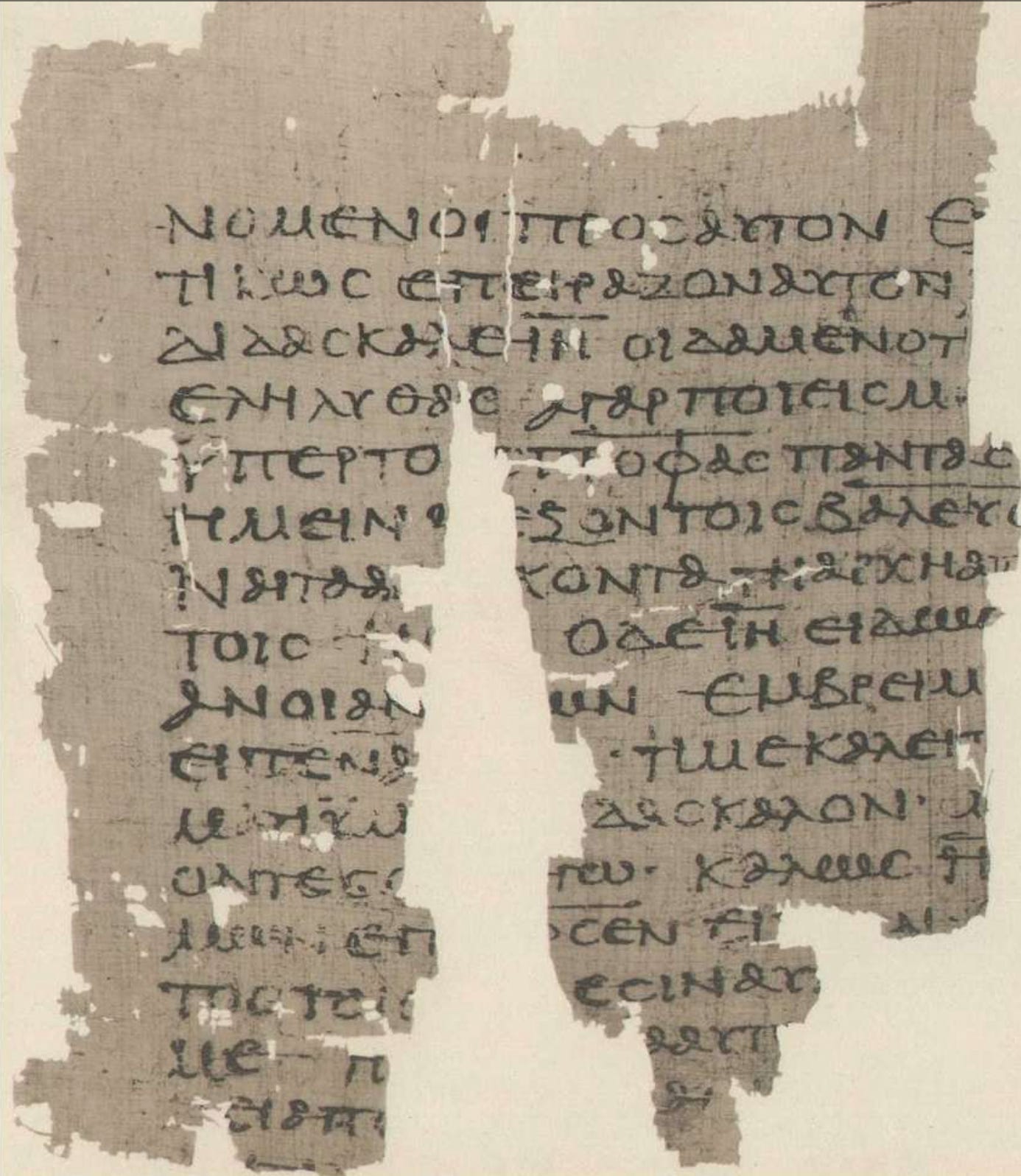
The Egerton Gospel
I believe that we may have an example of a lost gospel in the Egerton papyrus discovered in 1934. These fragments are often dated from the mid-to-late second century. When the results of the discovery were published by the British Museum in 1935, the scholars who translated the text wrote in their introduction that these fragments were “obviously part of a work designed on much the same lines as the canonical gospels. It may perhaps seem rash to affirm this so positively on the basis of two leaves and a small fragment; but the whole scale of the narrative, the variety of incidents recorded, the mixture of sayings and miracles, irresistibly suggest this conclusion…”9
If you’d like to read the full text of the Egerton Papyrus, you can find it here, along with various other resources. Because this Gospel is fragmentary and unprovenanced, we can’t be sure that it was written by one of the “eyewitness” who had been with Jesus “from the beginning,” but the fact that it has so much in common with the canonical Gospels (including Mt 8:2-4, 9:4, 12:24, 15:7-9, 22:17; Mk 1:40-44, 7:6-7, 12:14; Lk 4:30, 5:12-14, 6:46-47, 11:16; Jn 3:2, 5:39, 45, 8:48, 9:29), yet without any of the gnostic elements found in some of the later Apocryphal Gospels, indicates to me that it very well could be a fragment of one of the early Gospels referred to by Luke in his opening verse.10
What’s particularly intriguing about the Egerton papyrus is that, in addition to all the similarities to the canonical Gospels, this text also includes a report of a unique miracle performed by Jesus that isn’t recorded elsewhere:
While teaching near the Jordan River, Jesus asked those standing by, “How is it that a seed, when it is hidden and buried in the soil, can produce such abundance beyond measure?” When his hearers were perplexed by his question, Jesus walked to the bank of the Jordan, and stretching out his right hand, filled it with seed and sowed it in the ground by the river. And then he poured water over it, and it sprang up before them, and brought forth fruit.11
Perhaps the full text of this Gospel, and many others like it, have been permanently lost, or perhaps a few texts are still out there waiting to be discovered. I suspect that an important find of this nature would end up creating quite a stir—even among Christians. Is this new Gospel authentic? If so, should it be added to the canon? How these questions are answered, of course, depend largely on the results of the detailed examination and rigorous study of the texts in view. But according to my own reading of Luke’s prologue, I believe the discovery of additional unknown Gospels is a real possibility.
For earlier parts of this series on “Rethinking Luke’s Prologue,” use these links:
Part 1 with Thomas Randolph; Part 2 with Johann L. Hug; Part 3 with Daniel Whitby and George Gleig; Part 4 with John Jones and George Moberly; Part 5 with John Mill, Friedrich Bleek, B.F. Westcott and Henry Cadbury; Part 6 featuring a discussion of 1st and 2nd century sources, Part 7 featuring G. Wetzel, George L, Hahn, and Johann Peter Lange, and Part 8 featuring a discussion of the prologue’s parallel structure. Click here to get a pre-release PDF of Shane’s book Luke’s Key Witness, and here to watch his webinar, “Rethinking Luke’s Prologue” (exclusively for paid subscribers).
FOR FURTHER STUDY
Notes for Episode #78 (Egerton Papyrus info, etc.), Shane Rosenthal
Things Completely Fulfilled Among Us, Shane Rosenthal
His Excellency, The High Priest, Shane Rosenthal
The Implications of 70 AD on the Date of the Gospels & Acts, Shane Rosenthal
A Pre-70 Date for the Gospels & Acts, Shane Rosenthal
Outside the Gospels, What Can We Really Know About Jesus?, Shane Rosenthal
Is Luke a Trustworthy Historian?, Sir William Ramsay
Can We Trust Luke’s History of the Early Jesus Movement? Shane Rosenthal
On Faith & History, Shane Rosenthal
AUDIO
Did Josephus Ever Mention Jesus? #77 with T.C. Schmidt
Jesus in Josephus & Other Ancient Texts, #78 with T.C. Schmidt
Who is Theophilus? Humble Skeptic #79 with Peter. Bolt
Luke, Theophilus & Joanna, Humble Skeptic #80 with Jim Sibley
A Forensic Approach to the Gospels, Humble Skeptic #81 with J. Warner Wallace
Why The Gospel Holds Up as History, Faith Lab with Craig Keener
Lazarus, Humble Skeptic #84 with Richard Bauckham & T.C. Schmidt
VIDEO
Rethinking Luke’s Prologue: A Webinar by Shane Rosenthal for Paid Subscribers
Specifically, Josephus says that Jesus “drew over to him both many (πολλοὺς) of the Jews, and many of the Gentiles.” For a defense of the authenticity of this controversial passage, see T.C. Schmidt’s Josephus & Jesus, or you can listen to my interview with the author here.
According to Luke, the number of Jesus’ followers rapidly expanded from an initial core of 120 disciples (Acts 1:15) to around 3,000 (Acts 2:41), then to 5,000 (Acts 4:4), and by the late 50s, “many tens of thousands” (πόσαι μυριάδες; Acts 21:20). This explosive growth matches the evidence found in the NT epistles, which demonstrates that by the 40s and 50s, congregations of Christians were scattered throughout the Mediterranean world. See also 1Clem 6:1 and Tacitus, Annals 15:44 for references to the “vast multitude” of Christians in the city of Rome who were arrested, tortured and martyred for their faith.
Marcus Borg, Jesus: A New Vision (San Francisco: Harper Collins, 1987), 61.
In “The Identity of the Beloved Disciple,” I argue that the author of the Fourth Gospel should be identified with the unnamed disciple with Andrew mentioned in Jn 1:35ff.
Notice the way Luke applys this word to other officers in Acts 5:22 and 26.
For additional discussion of the Seventy, see Part 3 featuring the work of Daniel Whitby and George Gleig.
Cited by Simon Gathercole in, The Gospel and The Gospels (Grand Rapids: Eerdmans, 2022), 7-8, footnote 28. The original volume by Harold Bell and T.C. Skeat was titled, Fragments of an Unknown Gospel and Other Early Christian Papyri (1935).
If the Egerton Gospel was circulating before Luke penned his Gospel, some may wonder how we are to explain all the material it includes from John. In my view, the author may not have borrowed his material from a completed copy of John, but rather, it’s possible that both he and John received the material from a common source (i.e., Jesus himself).
Great thoughts. Well argued.
Regarding Aramaic: I has been a custom to assume no Hebrew was spoken in Galilee. That is contrary to the facts. (The idea was developed by Jews in Babylon (Babylonian Talmud) and I think unduly expanded by Dalman and his followers.
While there were Aramaic loanwords in the Hebrew of the first century, it was still Hebrew and alive. In Galilee they pronounced certain consonants differently, yet it was Hebrew, too.
Just like German speakers use many English terms and idioms in daily language, and increasingly so, people still speak German with one another.
Matthew wrote the Logia in Hebrew, not in Aramaic. Mark wrote for an eastern Greek-speaking audience with an Aramaic background. He was in the land of Babylon with Shimon. There was the greatest Jewish Diaspora.
Eusebius invented the story about Simon (and Mark) in Rome. Neither Paul nor Luke nor the synagogues there no anything about him being there.