
ReThinking Luke's Prologue, Part 11
Some argue that Luke was a second or third generation believer who recieved traditions about Jesus that had been "handed down" to him from others. But what does Luke really claim in his preface?


According to Australian NT scholar Michael Bird, “Luke acknowledges that he is a second- or third-generation believer in Jesus and is himself dependent on others in his narration.”1 Joseph Fitzmyer similarly argues that “Luke writes as a third-generation Christian, carefully marking his distance from the ‘events,’ and the eyewitnesses and ministers of the word…on whom he depends.”2 However, Joel Green challenges this interpretation of Luke’s prologue:
Some have seen in these verses evidence that Luke is a “third generation” Christian after the eyewitnesses and original compilers and narrators of the Jesus-story. Luke only reports that his time in writing comes after some accounts have already been attempted, however, not that he does not belong to that generation of Christian writers—or, for that matter, that he himself had not observed some of the events he narrated. Indeed, as the narrator of Acts, he explicitly claims to have participated in the events he recounts in selected passages. The prologue does, however, communicate Luke’s claim to being one of “us” — that is, a member of the larger community of persons whose lives were being shaped by the events he goes on to narrate.3
I completely endorse the above critique offered by Green. In my view, much of the problem stems from a misinterpretation of the first two verses in which Luke states that by his time, many had already compiled narratives about Jesus which the “eyewitnesses and ministers of the word delivered (παραδίδωμι) to us.” In some cases, the word delivered is interpreted to mean “handed down” over a great span of time, and often this view get intertwined with pre-existing beliefs about the dating of the Gospels.
Here’s how the logic works. If Matthew and Mark are to be included among the “many” narratives written by Luke’s day, since they are commonly dated by many scholars to sometime after 80 AD, it goes without saying that Luke must have been composed even later (i.e., some 50 years or more after the events originally took place). This is why it is frequently claimed that Luke was a second or third-century believer, who was exclusively dependent upon the narratives of Jesus’s original followers.
The First Problem
Theories and assumptions about the late date of Matthew and Mark should not be read into the meaning of Luke’s prologue. That is not exegesis, but eisegesis. In fact, I believe Luke makes clear in his opening verse that the events he is about to recount were completely fulfilled “among us” (ἐν ἡμῖν).4 In other words, Luke seems to be presenting himself, not as a second or third generation believer who is far removed from the events that took place around 30 AD, but as a member of the community who witnessed the fulfillment of at least some of these crucial events.
It’s interesting to note that Fitzmyer, who referred to Luke as a third generation Christian, seems to acknowledge this point when he says that that Luke’s use of ἐν ἡμῖν in verse 2 “has to be related to the use of the first plural pronoun in the We-Sections of Acts.” As such, “Luke implies that he has been a contemporary of and a witness to at least some of the events which he is going to recount.” Oddly, however, he goes on to state without explanation that this “does not mean that he witnessed any of the ministry of Jesus…”5
The Second Problem
On it’s own, the Greek word παραδίδωμι does not indicate that the eyewitnesses “handed down” the Jesus tradition over a long period of time.6 For example, in Luke 9:44, Jesus warned his disciples about the fact that he was “about to be delivered into the hands of men,” which, if memory serves, did not take place over a generation. As it happens, Luke uses the word παραδίδωμι this way in many places throughout his two volumes (cf. Lk 12:58, 18:32, 20:20, 21:12, 22:4, 23:25, 24:7, 20, Acts 3:13, 8:3, 12:4, 21:11, 22:4, 27:1, 28:17), and also employs a similar word when telling the story of Jesus’ visit to the synagogue in Nazareth (Lk 4:20). When he finished reading Isaiah, Jesus “rolled up the scroll and handed it back (ἀποδίδωμι) to the attendant” (ὑπηρέτῃ).7
The Third Problem
Though Luke makes clear that he belonged to the community that received the official narratives about Jesus from the eyewitnesses and guardians (ὑπηρέται) of the word, he also goes on in verse 3 to state that he too had been “a follower from the beginning.” As I’ve demonstrated throughout this series, many competent scholars over the centuries have argued that Luke’s language (particularly his use of the word παρηκολουθηκότι) makes clear that he had not investigated the story of Jesus, but had actually been physically present during the time of Jesus’ ministry. In fact, he clearly states that he was there from the very start (ἄνωθεν).
At this point it’s worth remembering that Luke’s preface is presented in a parallel structure. That which the eyewitnesses and guardians had delivered to communities of early Jesus followers, Luke was preparing to deliver to Theophilus. Why was he qualified to do this? Because like them, he too had been there “from the beginning.” Commenting on this parallel structure, Joel Green writes that “With respect to structure and style, Luke 1:1-4 is periodic, with one complete sentence made up of five clauses organized into a balance unity.” He then presents the following:
many have undertaken — I too decided
to set down an orderly account — to write an orderly account
the events that have been fulfilled among us — everything
from the beginning — from the very first
just as they were handed down to us — so that you may know.
“Accordingly,” Green concludes, “one recognizes between vv 1-2 and vv 3-4 a balance of phrases that guide the interpretation of Luke’s prologue”.8 I discussed many of these parallels in Part 8, and provided the following chart:
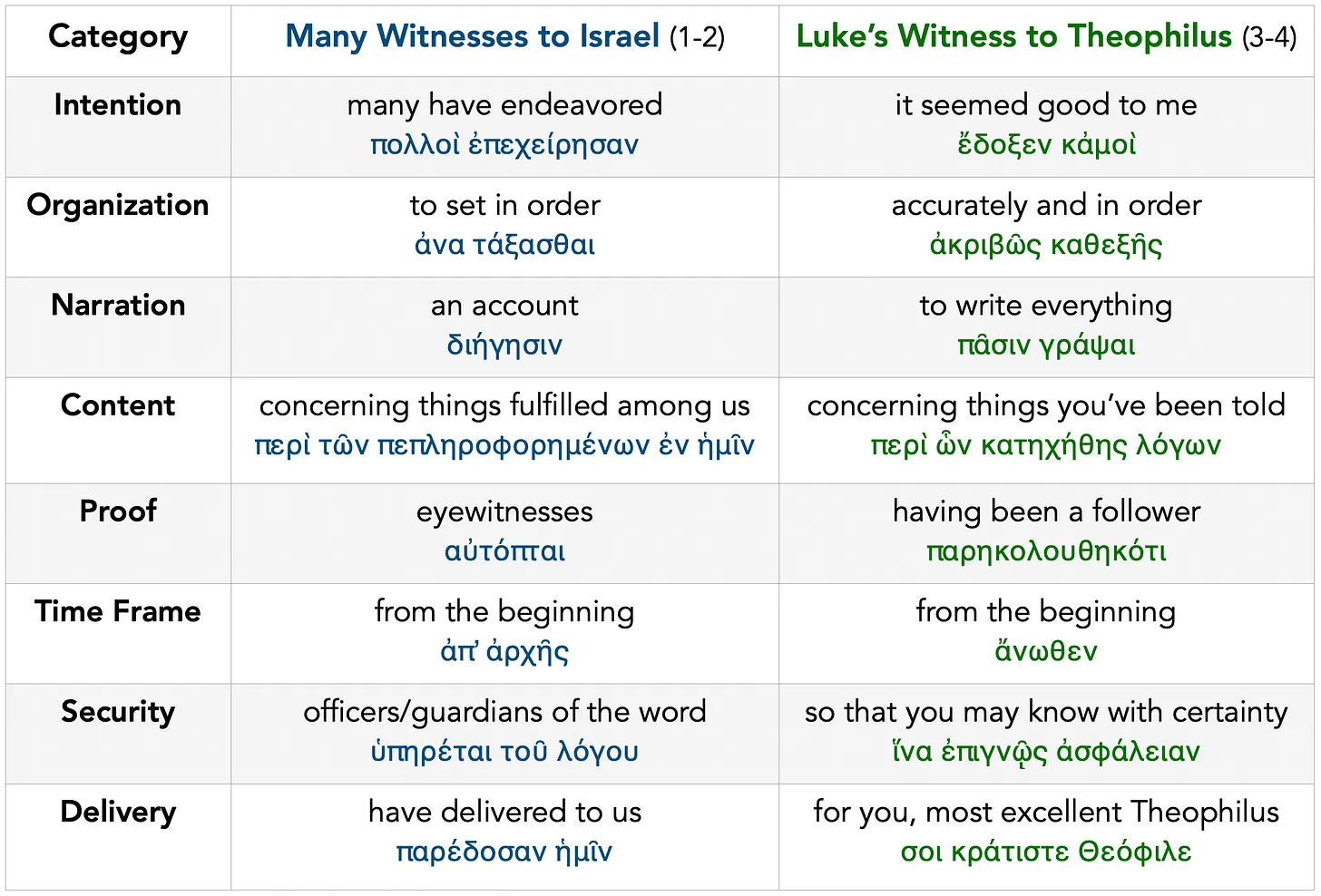
The way I see it, Luke was claiming to have precisely the same qualifications as “the eyewitnesses and guardians of the word” mentioned in verse 2.
In Part 1 of this series, Thomas Randolph wisely observed that “None of the Evangelists were eyewitnesses of everything which they relate.” If Luke had become a follower of Jesus during the first year of his ministry, why should we be surprised to find him relating some of the famous stories about Jesus that had also been recorded by Matthew, Mark, or both? The fact that he was part of the movement from the beginning should not be interpreted to mean that he was constantly at Jesus’ side or that he witnessed everything he did. But as a member of the early Christian community, he had excellent access to Jesus’ closest disciples.
This is why it’s important to affirm both sides of the parallel. As a member of the early Christian community, Luke was in some sense dependent on the eyewitnesses and guardians of the word (1:2). But since himself had been there “from the beginning” (1:3), and was part of the community that witnessed the fulfillment of Israel’s messianic promises (πεπληροφορημένων ἐν ἡμῖν; 1:1), he was also able to provide his own unique material when he related the story of Jesus to Theophilus.
For earlier parts of this series, use the following links: Part 1, Part 2, Part 3, Part 4, Part 5, Part 6, Part 7, Part 8, Part 9, and Part 10. To get a pre-release PDF of Shane’s book, Luke’s Key Witness, click here.
FOR FURTHER STUDY
Things Completely Fulfilled Among Us, Shane Rosenthal
His Excellency, The High Priest, Shane Rosenthal
The Implications of 70 AD on the Date of the Gospels & Acts, Shane Rosenthal
A Pre-70 Date for the Gospels & Acts, Shane Rosenthal
Outside the Gospels, What Can We Really Know About Jesus?, Shane Rosenthal
Is Luke a Trustworthy Historian?, Sir William Ramsay
Can We Trust Luke’s History of the Early Jesus Movement? Shane Rosenthal
On Faith & History, Shane Rosenthal
AUDIO
Who is Theophilus? Humble Skeptic #79 with Peter. Bolt
Luke, Theophilus & Joanna, Humble Skeptic #80 with Jim Sibley
A Forensic Approach to the Gospels, Humble Skeptic #81 with J. Warner Wallace
Why The Gospel Holds Up as History, Faith Lab with Craig Keener
Did Josephus Ever Mention Jesus? #77 with T.C. Schmidt
Jesus in Josephus & Other Ancient Texts, #78 with T.C. Schmidt
Lazarus, Humble Skeptic #84 with Richard Bauckham & T.C. Schmidt
VIDEO
Rethinking Luke’s Prologue: A Webinar by Shane Rosenthal for Paid Subscribers
Michael Bird, A Bird’s-Eye View of Luke and Acts (Downers Grove, IL: IVP, 2023), 55.
Joseph A Fitzmyer, The Gospel According to Luke, I-IX (New York: Doubleday & Company, 1981), 289.
Joel B. Green, New International Commentary on the New Testament: The Gospel of Luke, (Grand Rapids: Eerdmans, 1997), 36.
I discuss the implications of this in my article, “Things Completely Fulfilled Among Us.” Also, compare with the language of John 1:14, “The Word became flesh and dwelt among us (ἐν ἡμῖν), and we have seen his glory.”
Fitzmyer, 293-294. Similarly, Darrell Bock writes that “At the minimum, the first-person plural pronoun refers to those believers who saw the initiation of salvation history, the ‘first generation,’ but goes on to suggest that it does not include Luke himself. He says this in the Baker Exegetical Commentary on the New Testament: Luke, Volume 1: 1:1-9:50 (Grand Rapids: Baker Books, 1994), 57.
For example, Darrell Bock argues that “The reference to ‘us’ in 1:2 alludes to the tradition’s transmission to a later generation of the church, to those of Luke’s time (cf. p. 59 of the book referenced in footnote 5).
The root of both words is δίδωμι which means “to give.” παραδίδωμι refers to giving or handing over, whereas ἀποδίδωμι refers to giving or handing something back. In Luke 4:20, Jesus gives the scroll to the synagogue attendant (ὑπηρέτης), and in Luke 1:2, the eyewitnesses and guardians(ὑπηρέται) give the authorized narratives to the community of believers which includes Luke himself.
Joel B. Green, p. 36. Darrell Bock acknowledges the parallelism in his discussion of the meaning of ἄνωθεν from Lk 1:3. In his view, the word “can mean either ‘from the beginning’ or ‘for a longtime.’ If the latter translation is chosen, Luke refers to the length of study. The solution comes from Lucan usage. The parallelism of this expression with ἀπ’ ἀρχῆς in Lk 1:2…suggests the first meaning here.” (p. 61). I discuss the parallel structure of the prologue in more detail here.